A chore chart for kindergarteners works best when a child can see exactly what to do, finish a small job, and mark it themselves. Start with one familiar task, then build a short routine around a moment that already happens, such as arriving home or finishing dinner.
This guide includes a ready-to-print weekly chart, specific examples of what “finished” looks like, and ways to adapt a chore chart for kids of different ages. You can use the chart on its own or add a little variety with the OneFamli chore generator and spin-the-wheel game.

What belongs on a kindergarten chore chart?
Try one to three small jobs, such as placing shoes on a mat, putting used clothes in a hamper, or returning toys to a basket. Use a picture beside each task, show the child how to do it, and offer help when needed. This is a suggested starting routine, not a developmental requirement or a test of independence.
A chore chart for kindergarteners: choose clear, small jobs
“Clean your room” leaves a lot for a young child to work out. “Put the blocks in this basket” has a visible ending. Before adding a chore, ask: can my child reach the supplies, understand the action, and tell when it is done?
The American Academy of Pediatrics’ age-appropriate chore guidance includes putting toys away, sorting laundry, and setting or clearing the table among options for ages five to seven. It recommends introducing a new task one at a time and supporting children as they learn. Choose from those broad ideas according to your child's abilities and the setup of your home.
| Chart wording | What finished looks like | How an adult can help |
|---|---|---|
| Park my shoes | Both shoes are on the entry mat. | Mark a spot with a picture of shoes. |
| Put clothes in the hamper | The used clothes from changing are inside. | Keep the hamper low and easy to open. |
| Put blocks in the basket | The blocks from this play session are put away. | Choose one toy type instead of the whole room. |
| Bring my cup to the counter | An unbreakable cup is in the agreed place. | Choose a reachable surface away from hot items. |
| Put out napkins | There is one napkin at each place. | Count the places together first. |
| Pair clean socks | Two or three matching pairs sit together. | Offer a small pile with obvious matches. |
| Straighten my blanket | The blanket covers most of the mattress. | Hold one corner together; skip a perfect finish. |
| Return three books | Three books are in the low book basket. | Use a basket if a tight shelf is difficult. |
These are choices, not an eight-task daily checklist. Pick one that already feels manageable. Keep sharp objects, hot cookware, cleaning products, heavy loads, and climbing out of a young child's assigned jobs. Adults should decide the safe setup and level of supervision.
Free printable chore chart for kids
Use this simple seven-day chart for one child. The first three rows are examples; the extra rows let you write your own. Cross out unused rows so the page reflects what you actually expect. A tick can mean “finished with help” as well as “finished on my own.”
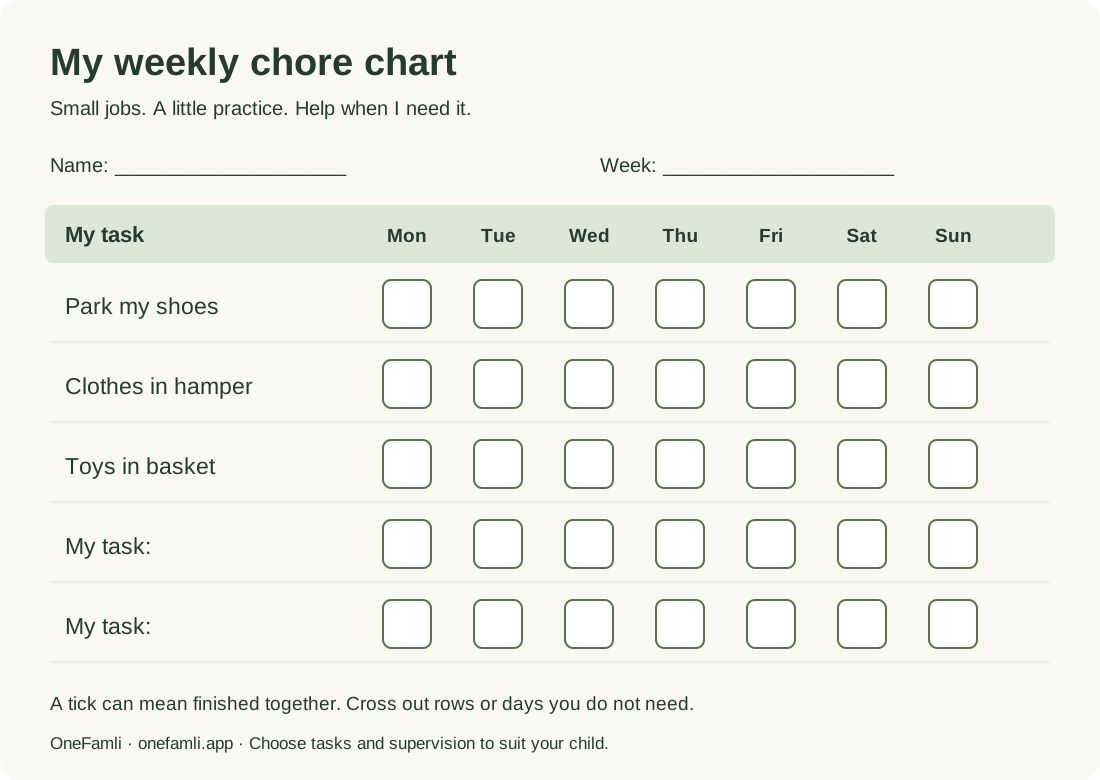
Open the free printable chore chart
The print page needs no account and has no sign-up form. Open it, choose Print, and select your printer or Save as PDF. Write in your child's name and the week. If you prefer a picture chart, draw a shoe, a shirt, and a toy basket beside the matching rows, or attach your own photos of the actual storage spots.
How to set up a chart your child can use
- Choose the moment. Place “park my shoes” after coming home, rather than at an unrelated time when shoes are already scattered.
- Show one complete example. Point out the starting place, the destination, and what the finished job looks like. Keep the explanation short.
- Do it together. Let the child take one part while you handle another. Helping is a way to teach the task, not a reason to withhold a check mark.
- Put the chart where the action starts. An entryway chart can work better for shoes than a chart hidden in a bedroom. Keep pencils or stickers accessible if appropriate for your child.
- Review the routine after a week. Keep a task that fits. Make an awkward task smaller, move the supplies, or change the time. Add another job only when the routine feels manageable.
For a first-week trial, spend the first couple of days practicing one job together. During the middle of the week, let the child begin with a brief reminder. At the weekend, look at the chart together and ask which part was easy or confusing. This is a flexible example, not a promise that a habit will form in seven days.
Adapt a chore chart for kids as they grow
Ages are a rough way to organize ideas, not a readiness checklist. The useful difference is often the size of the job and the amount of help. A child who is new to a task may need the same demonstration as a younger sibling.
| Starting point | Example task | Possible next step |
|---|---|---|
| Preschool, often ages 3–4 | Carry one soft toy to its basket with you. | Choose between two familiar tidy-up jobs. |
| Kindergarten, often ages 5–6 | Return one category of toys to a labeled spot. | Check the picture chart and begin with a reminder. |
| Early elementary, often ages 7–8 | Put folded clothes into accessible drawers. | Complete a short two-step routine with a check-in. |
| Older children, often ages 9–12 | Help organize a shared shelf or prepare a meal area. | Help plan when a weekly household task will happen. |
For siblings, share a household goal but give each child a suitable part. One child might place napkins while another clears safe table items and an adult handles hot dishes. Avoid comparing the number of ticks when the jobs and support needs differ.
Children who find reading, movement, transitions, or sensory input difficult may need a different format. Try a single picture, a lighter basket, a reachable work surface, or a predictable verbal cue. Include the child in choosing the adjustment. A useful chart fits the child rather than asking the child to fit the chart.
Turn a small tidy-up into a game
The free OneFamli chore generator lets you edit starter chores, remove unsuitable ones, add your own tasks and rewards, and spin a wheel to choose a chore. No account is needed for the public wheel. An adult should curate the list first, because a random choice cannot decide what is safe or suitable for a child.
1. Spin and help
Add three familiar choices, such as “park shoes,” “pair socks,” and “put books in the basket.” Spin once, then complete the selected task together. Treat the wheel as a choice-maker, not a race or a punishment. Remove a completed task if you do not want it selected again.
2. One-song reset
Choose one area and play a familiar song. Everyone helps with that area until the song ends, then checks what is left. If music or time pressure is distracting, skip the timer and choose a small target, such as returning five toys instead.
3. Find the matching home
Draw matching symbols on a toy basket and its picture card. Ask the child to find the object's “home.” This works especially well when a written label alone is not useful yet. Keep the choices simple and let the child help decide the pictures.
Make the next small job easier to choose
Build a short, child-appropriate list and try the wheel together.
Play the chore wheel gameWhen the chore chart is not working
- The child does not start: move the chart closer, point to one picture, and begin the first action together.
- The job stays half finished: replace a broad label with one action. “Tidy the playroom” can become “put cars in the blue box.”
- Every evening becomes an argument: try a less tiring time or fewer tasks before adding consequences or rewards.
- A day is missed: leave it blank and continue. The chart is a record of practice, not a debt that must be repaid tomorrow.
- The reward becomes the whole focus: agree on the arrangement before starting and keep it simple. Talk about the useful result as well, such as having a clear place to play.
If you use rewards, they can be non-money choices such as picking a family game. Keep ordinary care, food, affection, and rest separate from earning ticks. You can use the family budget calculator to plan a small allowance if that suits your household, but a chore chart does not require payment.
Chore chart questions parents ask
How many chores should a kindergartener have?
Start with one new job. A short chart with up to three familiar tasks is a practical option to try, not a fixed rule. Reduce the list if it regularly needs more effort or support than your child can manage.
What if my child cannot read yet?
Use a drawing or photo of the task and its finished result. Show the child how to mark the row. A picture of their own shoe mat may be easier to recognize than a generic symbol.
Should I use a daily or weekly chore chart?
A weekly chart makes repeated jobs easy to see in one place. If seven columns feel busy, cover the other days or use one daily card. Keep occasional jobs separate so blank boxes do not look like missed work.
Can a chore wheel replace a chart?
The wheel chooses a task; the chart records a routine. Use the wheel when you want a playful choice between suitable jobs, and the chart when you want a visible reminder of recurring tasks.
Do we need to finish every box?
No. Choose the rows and days that fit your plan. Leave room for illness, busy days, and tasks done with help. Review what was useful instead of chasing a perfect page.
Connect chores with the rest of family life
A short chore routine is easier to place when you can see the rest of the week. Use the shared calendar planner to plan a family reset, or visit the OneFamli home page to explore tools for everyday family planning. Start with one job that makes tomorrow a little easier.
Sources and editorial notes
For broader age guidance, see the American Academy of Pediatrics’ chore guidance. The requested reference, Treehouse Schoolhouse’s age-based chore lists, informed the idea of an illustrated guide with a printable resource. This article, task examples, chart design, and illustrations were created for OneFamli rather than copied from that page.
Written for OneFamli. Reviewed by: Olivia Parker. These are flexible household-planning ideas, not an assessment of a child's development. Choose tasks and supervision to suit your child.